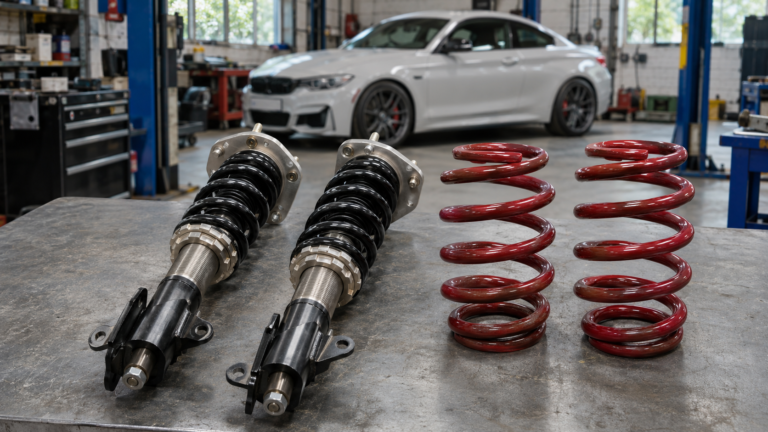
Wheel spacers move the wheels further out from the hubs. They can improve the way a car sits in its arches or provide useful clearance, but the right choice depends on the wheels, tyres and suspension already fitted.
A spacer isn’t suitable simply because its bolt holes line up. Correct centring, secure fixings and enough clearance throughout steering and suspension movement are all part of the job.
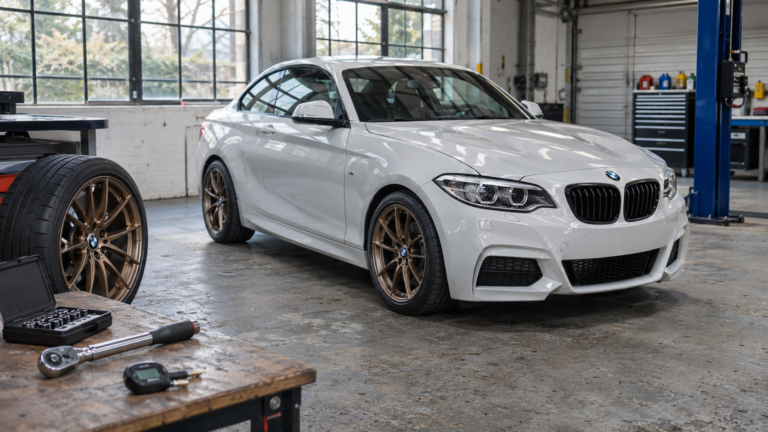
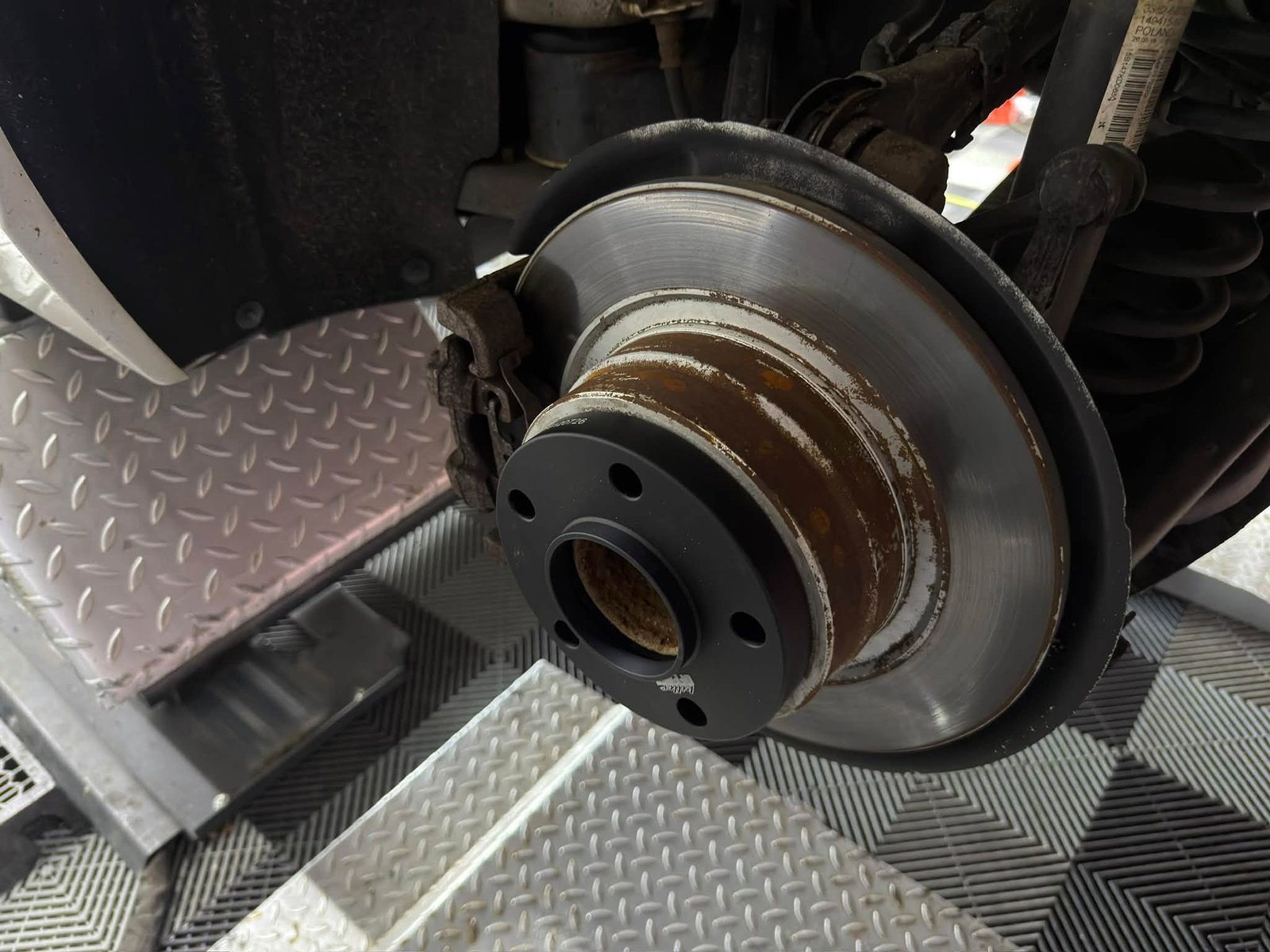
I recently had wheel spacers fitted to my BMW 218i by Lee at LF Automotive in Warrington. The photographs accompanying this guide show the car at the workshop and a spacer in place with the wheel removed.
What do wheel spacers actually do?
A wheel spacer sits between the wheel and its mounting surface on the hub. Its thickness determines how far the wheel moves outwards.
Fit a 10 mm spacer on each side of an axle and each wheel moves out by 10 mm. The distance between the wheel centrelines across that axle, known as the track width, increases by 20 mm.
That distinction matters when ordering. Some listings describe spacer thickness per wheel, while others quote the total widening across an axle. A “20 mm kit” needs checking before you assume what’s in the box.
How spacers change wheel offset
Offset, usually marked ET, describes the position of the wheel’s mounting face relative to its centreline. Adding a spacer reduces the effective offset of the installed combination.
Effective offset = wheel ET − spacer thickness per wheel
An ET40 wheel fitted with a 10 mm spacer therefore sits in the same lateral position as an otherwise identical ET30 wheel. Its stamped offset remains ET40.
H&R’s technical guidance uses this calculation when assessing wheel-and-spacer combinations. It’s a useful starting point, but it doesn’t establish whether the resulting fitment clears everything on your car.
Why do people fit wheel spacers?
The most obvious reason is appearance. Moving a recessed wheel closer to the arch can give the car a broader stance without replacing the alloys.
There can also be a practical clearance benefit. Moving the wheel outwards may create more room between its inner edge and a suspension component. In some applications, a correctly specified spacer can provide extra clearance between the spokes and a brake caliper.
That benefit comes with a trade-off: space gained on the inside is taken away on the outside. The tyre moves closer to the arch and surrounding bodywork.
Spacers don’t increase tyre width, lower the suspension or automatically improve grip. A wider stance may look more purposeful, but handling changes depend on the complete setup.
Slip-on and bolt-on spacers explained
The two broad arrangements use different methods to secure the wheel.
| Spacer type | How it works | Important check |
|---|---|---|
| Slip-on | Slides over the hub; the wheel fixings pass through it | Appropriate bolt or stud length and thread engagement |
| Bolt-on | Fixes separately to the hub; the wheel then fixes to the spacer | Compatibility of both fixing interfaces and any protruding hardware |
Slip-on systems commonly require longer wheel bolts or replacement studs. Bolt-on systems have their own installation requirements, which can include clearance for the original studs or bolts behind the wheel.
Neither arrangement should be chosen on name alone. Use the system approved by its manufacturer for your vehicle and wheel combination.
What does hub-centric mean?
On a hub-centred fitment, the wheel locates on a central spigot. A suitable spacer must preserve the correct centring arrangement.
Many thicker hub-centric spacers locate on the original hub and provide a replacement lip for the wheel. Some thin spacers rely on enough of the original hub lip remaining exposed.
The hub lip’s length, the spacer’s internal shape and the wheel’s centre-bore chamfer all matter. A spacer can have the right nominal bore diameter yet fail to sit properly.
Hub-centric describes a centring feature. It doesn’t certify the quality of the part or prove the complete installation is suitable.
How to choose the right spacer thickness
Start by recording the wheel width, offset, tyre size and any suspension modifications. Check the space available at the outside of the wheel and identify the clearance problem or appearance change you actually want.
A straightedge beside the arch can help assess the parked position, but that measurement isn’t the maximum spacer size you can safely fit. The tyre flexes, the suspension moves and the front wheels turn.
Have a competent fitter check:
- Tyre clearance through steering movement.
- Clearance as the suspension compresses.
- The effect of passengers and luggage.
- Wheel-to-brake and wheel-to-suspension clearance.
- Correct centring and full contact between mounting faces.
- Suitable fixings and required thread engagement.
There’s no universal thickness that’s right for every BMW, Golf or other model. Wheel specifications and suspension changes can make two apparently similar cars very different.
Choose a combination with adequate clearance for normal use. Chasing the last few millimetres of outward position is rarely worth introducing rubbing.
Common wheel spacer mistakes
Reusing unsuitable wheel bolts
With a slip-on spacer, the original bolts may no longer reach far enough into the hub. A bolt that starts threading isn’t proof of sufficient engagement.
Bolts that are too long can also foul components behind the hub. The thread diameter, pitch, seat shape and length all need to suit the installation, including any locking bolts.
Follow the spacer and wheel manufacturers’ specifications. Don’t apply an arbitrary number of turns to every vehicle.
Fitting over dirty or uneven surfaces
Rust scale, dirt or an obstruction can stop the spacer sitting flat. The same applies to the wheel mounting face.
Eibach’s installation instructions require clean mating surfaces and checks that the spacer fits the hub and wheel correctly. If those checks fail, the instructions say not to continue.
A spacer shouldn’t be pulled into place with the wheel bolts. If it won’t sit flush, investigate the obstruction or incompatible dimensions.
Stacking spacers
Don’t stack separate spacers to make up a desired thickness. Use one correctly specified spacer at each wheel unless an explicitly engineered system’s manufacturer directs otherwise.
Adding another disc introduces another interface and can compromise centring and fixing suitability. Buying the correct thickness is the straightforward solution.
Assuming tighter is better
Final tightening needs a calibrated torque wrench and the specification appropriate to the vehicle, wheel and spacer system. An impact gun alone doesn’t verify the finished torque.
Also follow the manufacturer’s instructions on thread condition and lubrication. Adding grease or anti-seize without approval can change the clamping force produced at a given torque.
Forgetting the follow-up check
Follow the kit’s specified schedule for checking the fixings after installation. Intervals vary, so use the instructions supplied with your parts.
If new vibration, knocking or rubbing develops, stop using the car until the cause has been checked. Don’t dismiss it as something that needs to settle.
Do spacers put extra load on wheel bearings?
Moving the wheel outwards changes the leverage through which road forces act on the hub and bearing assembly. It can also change steering geometry and the way impacts are felt through the steering.
The consequences depend on the original design, effective offset, wheel and tyre package, and use. There isn’t a reliable mileage figure for how long bearings will last after fitting spacers.
A modest, properly assessed change is a different proposition from a large departure from the intended fitment. Neither should come with a promise of zero mechanical effect.
Insurance and MOT considerations
Tell your insurer about the proposed spacers before fitting and confirm that it will cover the modification. Admiral’s guidance advises customers to declare planned changes because acceptance and premiums can change.
Spacers don’t automatically mean an MOT failure. However, wheel security, compatible fixings and tyre clearance remain relevant.
The DVSA MOT manual lists incompatible wheel fixings and a tyre fouling part of the vehicle as major defects. Loose or missing fixings can be classed as major or dangerous, depending on the circumstances.
An MOT pass isn’t a complete approval of a modified wheel setup. The car still needs to be suitable for road use throughout its normal operating conditions.
My BMW’s spacer fitting at LF Automotive

Lee at LF Automotive in Warrington fitted the spacers to my BMW 218i. Having the work carried out professionally meant the installation was handled at the workshop rather than treating it as simply slipping a disc behind each wheel.
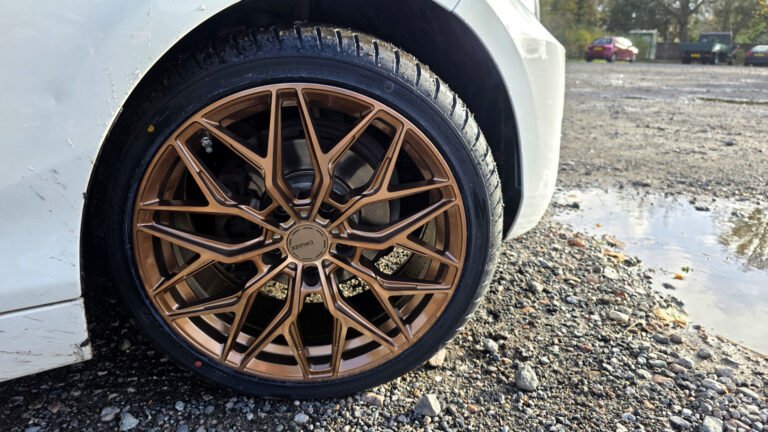
The close-up photograph shows why this is a fitment job: the spacer sits directly within the assembly that locates and secures the wheel.
I’ve also recently changed the BMW’s alloys. Whenever wheels change, spacer suitability needs reassessing because different widths and offsets can alter the final position substantially. A setup that suits the previous wheels isn’t automatically suitable for their replacements.
Are wheel spacers worth fitting?
They can be worthwhile when there’s a clear aim and a properly checked combination. Bringing recessed wheels out slightly or solving a specific clearance issue can justify them.
If you’re buying new alloys anyway, compare the cost and suitability of wheels with the correct offset before adding spacers to the plan.
For an existing set of wheels, choose vehicle-specific parts with clear fitting instructions, use the correct hardware and have the complete setup checked. The finished stance matters, but secure mounting and usable clearance come first.