Wheel offset determines where an alloy wheel sits in relation to the car’s hub.
Get it wrong and a wheel can sit too far inside the arch, stick too far out or leave too little clearance around the suspension.
Choosing the right alloys means checking offset alongside wheel width, tyre size and the vehicle’s other fitment requirements. An 18-inch wheel with the correct bolt pattern can still be completely unsuitable.
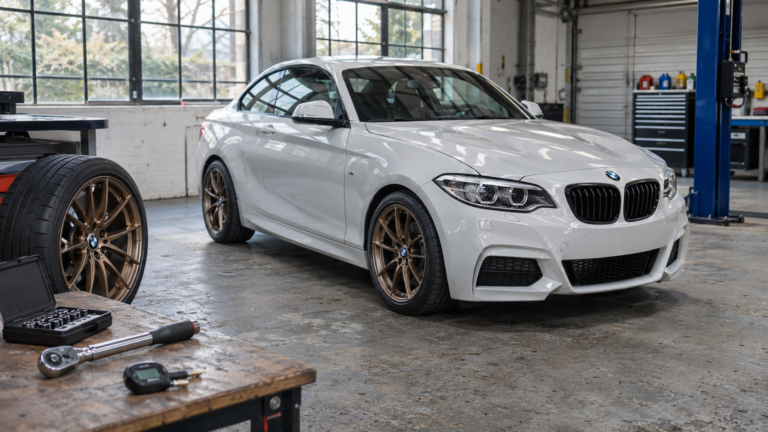
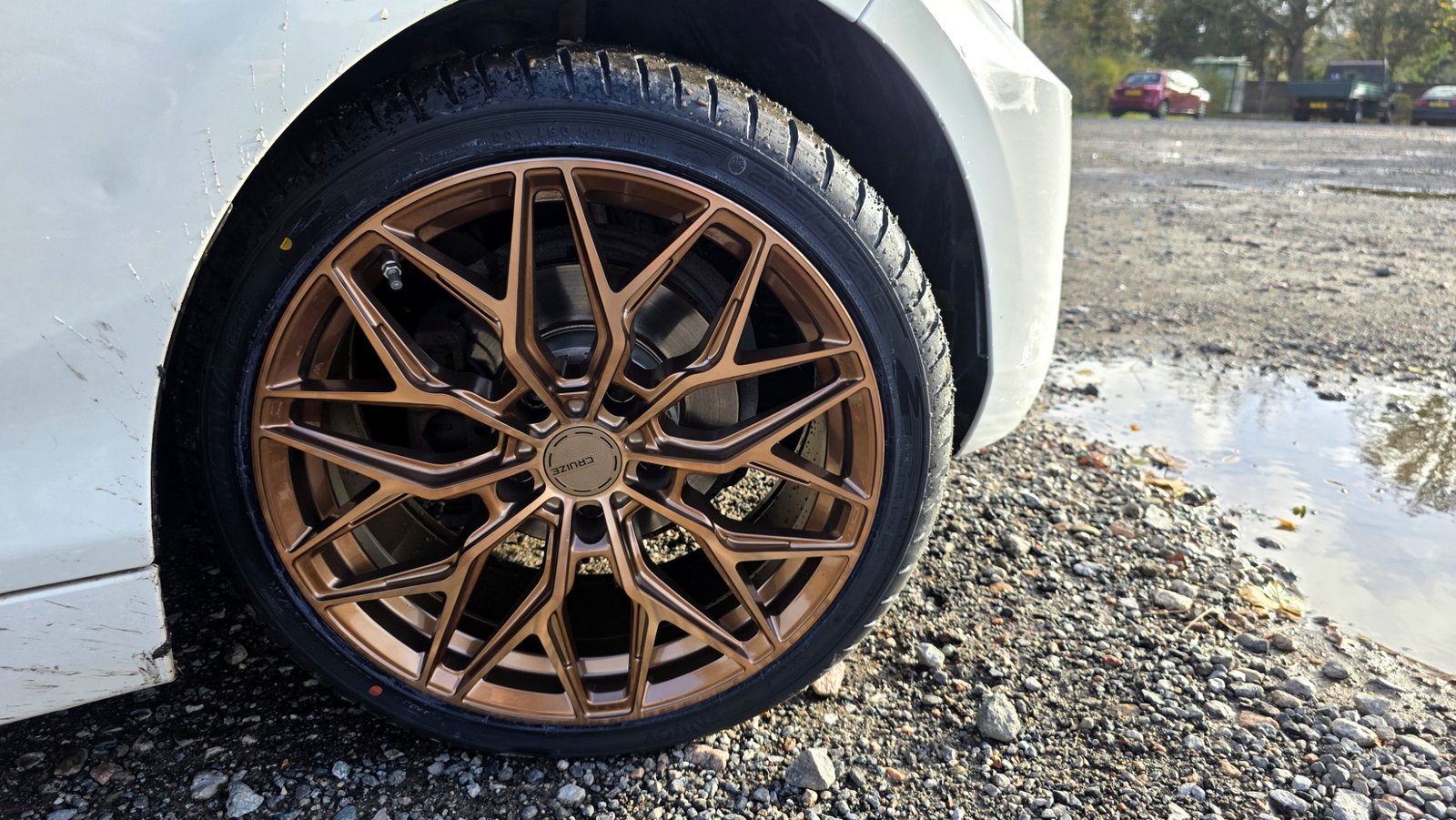
I recently changed the alloy wheels on my BMW 218i, fitting a bronze set that gives the car a different look. It’s a useful example of why wheel shopping involves more than choosing a design: diameter, width and offset all need to work together.
What is wheel offset?
Offset is the distance between a wheel’s centreline and its hub-mounting face, measured in millimetres. The mounting face is the flat surface on the back of the wheel that sits against the hub.
Imagine looking at the wheel in cross-section. Its centreline runs halfway across the rim’s width. Offset describes how far the mounting face sits to either side of that line.
OZ Racing’s wheel measurement guide identifies this measurement as ET, from the German word Einpresstiefe. That’s why listings use markings such as ET35 or ET45.
Positive, zero and negative offset
| Offset type | Mounting-face position |
|---|---|
| Positive | Towards the outside face of the wheel from its centreline |
| Zero | In line with the wheel’s centreline |
| Negative | Towards the inside edge from the centreline |
Many modern road cars use positive-offset wheels. Negative offset is more common on certain deep-dish and off-road applications, but appearance alone won’t reliably identify a wheel’s specification.
For wheels of the same width, a higher ET number moves the wheel further into the arch. A lower ET number moves it outwards.
For example, changing from ET45 to ET35 moves an otherwise equivalent wheel 10 mm outwards. That increases clearance on the inside by 10 mm while using up 10 mm of clearance on the outside.
Why wheel width changes the answer
An offset number only tells part of the story. Two wheels marked ET35 won’t occupy the same space if one is substantially wider.
At the same offset, increasing width adds equally to the inside and outside of the wheel. A move from 8 inches to 9 inches adds 25.4 mm overall, putting roughly 12.7 mm more rim on each side.
That means less room beside the suspension and more wheel towards the arch. Changing offset as well shifts that wider wheel inwards or outwards.
Here’s a worked example comparing two hypothetical wheels on the same hub, without spacers:
| Specification | Existing wheel | Replacement wheel |
|---|---|---|
| Width | 8 inches | 9 inches |
| Offset | ET40 | ET35 |
The replacement is 25.4 mm wider, adding 12.7 mm on each side. Its 5 mm reduction in offset then moves the wheel 5 mm outwards.
The result is approximately:
- 17.7 mm more outward extension towards the wheelarch.
- 7.7 mm less inner clearance beside the suspension.
These are calculated changes in nominal rim position, not proof that the wheel fits. Rim-flange design and the fitted tyre’s actual dimensions still need checking.
How to calculate the change
Convert the difference in wheel width to millimetres, then divide it by two.
Extra outward extension = half the width increase + old ET − new ET
Loss of inner clearance = half the width increase + new ET − old ET
A negative result means movement in the opposite direction. If spacers are fitted, use the effective offset of each complete setup when comparing them.
These calculations help you shortlist wheels. They don’t replace a physical clearance check.
What happens if the offset is wrong?
Too much inward positioning can put the tyre or rim close to a suspension strut, spring seat or other component. Too much outward positioning can create contact with the wheelarch as the suspension compresses or the steering turns.
Large departures from the intended fitment can also affect steering behaviour and the loads acting through the hub and bearings. There isn’t a universal “safe” number of millimetres that applies to every car.
Brake clearance needs checking separately. Two alloys with identical diameter, width and offset can have different spoke shapes and inner-barrel profiles. One may clear a brake caliper while the other doesn’t.
A wheel that bolts on and turns freely with the car lifted hasn’t yet passed every fitment check.
How do wheel spacers affect offset?
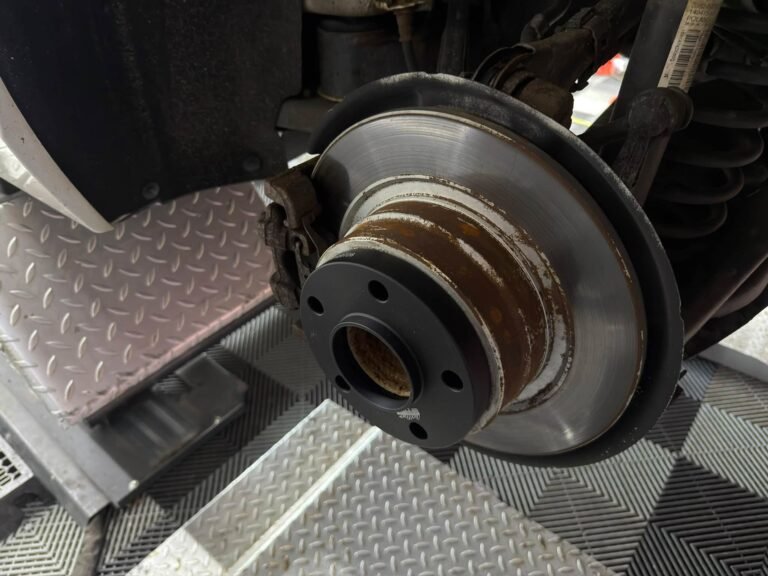
A spacer moves the wheel outwards by sitting between its mounting face and the hub. It reduces the effective offset by its thickness.
Effective offset = wheel ET − spacer thickness per wheel
For example, an ET40 wheel with a 10 mm spacer has an effective offset of ET30. The wheel’s stamped specification remains ET40; its installed position has changed.
H&R’s spacer guidance uses this subtraction when assessing wheel-and-spacer combinations. Its instructions also explain why the fixing arrangement and bolt specification depend on the spacer system.
Spacers can solve a particular clearance issue, but moving the wheel outwards also reduces space at the arch. They aren’t a general cure for incompatible alloys.
If you already have spacers and change wheels, reassess the whole combination. A spacer chosen for the previous wheels may no longer be appropriate.
The other measurements you need to check
Offset works alongside several specifications. Before ordering, ask the supplier to confirm compatibility with your exact model, suspension and brake package.
- Diameter and width: Both must suit the vehicle and selected tyres.
- Bolt pattern or PCD: The number of fixing holes and the diameter of the circle through their centres must match the application.
- Centre bore: The wheel must locate correctly on the hub, using the specified centring arrangement.
- Load rating: Each wheel must have sufficient capacity for its intended vehicle and axle.
- Fixings: Bolt or nut thread, seating shape and length must be correct.
- Brake clearance: Spoke and barrel shapes must clear the fitted brakes.
- TPMS compatibility: Check provision for compatible tyre-pressure sensors where required.
A larger centre bore may be accommodated by the wheel manufacturer’s specified spigot rings. Rings don’t correct a wrong bolt pattern, unsuitable offset or inadequate brake clearance.
Don’t assume the original wheel bolts suit the replacement alloys. A fixing can have the correct thread while having the wrong seat or length.
Tyre size matters as much as wheel position
The tyre is often the widest part of the assembly, so calculating rim position alone won’t establish clearance.
Check the tyre manufacturer’s permitted rim-width range for the specific size. Different tyre models can also have different actual widths and shoulder shapes despite sharing the same nominal size.
Michelin’s guidance on changing tyre sizes recommends checking the vehicle’s approved options and suitability before changing dimensions.
Going up in wheel diameter usually means choosing a lower-profile tyre to maintain an appropriate overall diameter. The correct combination must also meet load and speed requirements and suit the vehicle’s systems.
On four-wheel-drive cars, approved front-to-rear rolling-circumference relationships can be particularly important. Don’t copy a staggered setup from another version without checking.
What my BMW wheel change illustrates
The bronze alloys on my BMW have changed its appearance considerably, especially against the white bodywork. The accompanying photographs show the new wheels from several angles, including close-ups of the tyres and rims.
They’re useful for showing the finished look, but photographs can’t establish the exact offset or prove clearance under load. Those details come from the wheel specification and checks on the car.
That distinction matters when browsing other owners’ setups. A photograph may not reveal spacers, suspension changes, tyre dimensions or arch work. “It fits mine” is a starting point for questions rather than a complete fitment specification.
How to choose alloys that fit properly
Start with the existing wheel specification and an approved fitment for your exact car. Record the diameter, width, ET and any spacer thickness before comparing alternatives.
Give the supplier details of suspension changes, spacers and upgraded brakes. Ask for written confirmation of the proposed wheel-and-tyre combination.
Have a competent fitter check clearance through steering movement and suspension travel, including the effect of carrying passengers and luggage. A parked car with an empty boot doesn’t show every condition the wheels will encounter.
Use the specified fixings and tightening torque, and follow the supplier’s instructions for any subsequent torque check. Confirm insurance cover for the wheel change before fitting.
The aim is a combination that looks right and works throughout the car’s normal use. An alloy wheel needs to do more than fill an arch neatly.