Nowadays, if you park a low-slung sports car beside a fighter jet, the family resemblance is hard to miss.
Car designers can learn aerospace engineering practices such as shaping airflow, trimming weight and testing ideas with discipline.
For enthusiasts, the appeal is in seeing how those methods influence the cars you drive, admire and hope to own, down to the individual components.
Aerodynamics Still Separates the Winners From the Rest
Electric vehicle (EV) manufacturers need to pay attention to airflow alongside battery capacity. Aerospace thinking encourages designers to follow the air across the entire body, considering how each surface affects the next. A sleek nose is just the starting point.
In 2025 wind-tunnel testing, a redesigned battery-electric tractor demonstrated a 16% drag reduction over conventional design with the trailer configuration unchanged.
Pairing that tractor with a low-drag trailer increased the reduction to as much as 41% against a conventional tractor and standard trailer. These figures describe tests of 30%-scale models.
That larger improvement makes the interaction between components worth examining. On a car, designers should test a proposed bumper alongside the underbody, wheels and rear bodywork to understand its contribution.
Ask where the air goes after passing the revised surface, then check whether the complete package delivers the intended improvement.
Lightweight Materials Are Reshaping What a Car Can Be
Aerospace lightweighting determines the exact amount of material a component needs to function, blending material selection and geometric design into a single process. Car designers can carry that thinking into everyday hardware, including parts you might replace over the life of ownership.
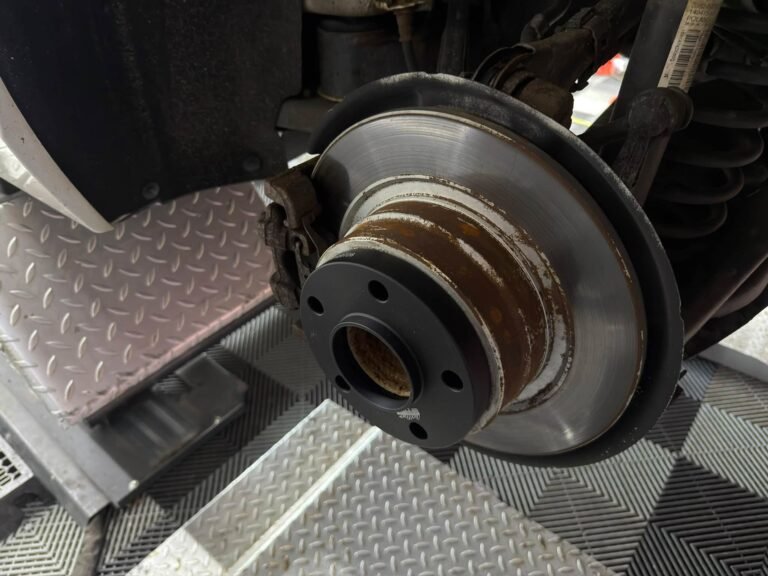
With roots in spaceflight materials engineering, one aftermarket rotor design combines cooling features with discs at least 42% lighter than conventional cast iron rotors.
Reported performance is comparable to carbon-ceramic alternatives, and applications include the Ford Mustang and some Tesla models. Owners can purchase these as aftermarket replacements.
Designers also need to weigh a lighter part’s manufacturing requirements, replacement costs and service needs. Before selecting a material, the team should consider how a workshop would inspect the component and what replacing it would involve.
Generative Design Creates Lighter Structures
Material choice is one part of lightweighting. Generative design lets engineers explore how changing a part’s shape could save weight. The team gives the software a specific problem to solve by defining loads, mounting locations, available space and manufacturing constraints.
An optimized EV compressor bracket achieved a 66% mass reduction compared with its legacy design. The first natural frequency increased by 22%, while material cost decreased by 22%. The workflow combined artificial intelligence with computational structural analysis. That increase in frequency specifically describes a change in vibration behavior.
The proposed shape still needs to suit the production vehicle. Engineers should check access around mounting points, compatibility with neighboring parts and whether ordinary tools can reach the fasteners. Defining those requirements early gives the software useful boundaries and keeps the resulting shapes relevant to the assembly team.
Observation and Testing Separate Good Designs From Great Ones
Before approving a promising shape, engineers need to decide which measurements would demonstrate an improvement. A clear test question gives the team something specific to investigate, while consistent conditions make comparisons easier to interpret.
Observation-heavy fields teach the same discipline aerospace engineers rely on before making design decisions. Learning tools like telescopes, binoculars and digital telescope cameras train observers to interpret what an instrument shows rather than assume what they expect to see. Vehicle development calls for the same patience when comparing simulation results, wind-tunnel data and real-world performance.
When a simulation predicts an improvement, test that prediction under defined conditions and investigate any mismatch. A disappointing result deserves a closer look before the team changes the design again. Check the assumptions, repeat the measurement where appropriate and use the evidence to decide what to adjust next.
The Next Generation of Cars Is Already Borrowing From Space
Electric powertrains, automated driving and in-car connectivity are becoming priorities in the automotive space. Alongside the EV market’s rapid growth, these trends give designers reasons to examine how new features fit the complete vehicle.
Evaluate each proposed feature against the vehicle’s packaging, energy demands and maintenance needs. Consider a sensor installation, for example. Designers should ask where it fits, how technicians would reach it and what its supporting equipment requires. Following those connections gives a feature’s development team a broader set of questions to resolve.
You can judge innovation by examining how convincingly each feature improves the complete vehicle. When a design catches your attention, ask what it contributes and which compromises accompany it. That habit brings the discussion back to engineering decisions you can evaluate.
Why the Best Car Designers Keep Looking Up
Curiosity about flight gives car designers useful questions about airflow, weight, structure and testing. For enthusiasts, those questions are another way to appreciate a familiar vehicle. Next time you study a favorite car, follow its surfaces and consider the decisions behind its components. The connection to aerospace may become clearest in the smallest detail.