Repeated bouncing after a bump points more towards weak shock absorbers. Knocks as you brake, pull away or change direction can point towards worn bushes or another loose suspension joint. Neither symptom confirms the failed part on its own.
The two problems can feel similar from the driver’s seat, and they can occur together. Tyres, springs, top mounts, ball joints and anti-roll-bar links can also produce overlapping symptoms.
This guide explains the differences, the checks worth making and when to stop driving rather than wait for a service.
Bushes and shock absorbers do different jobs
Suspension bushes are flexible mountings that allow controlled movement between components while reducing vibration and noise. They are commonly rubber bonded to metal, although other designs exist. A worn control-arm bush can let the wheel’s position change excessively under load.
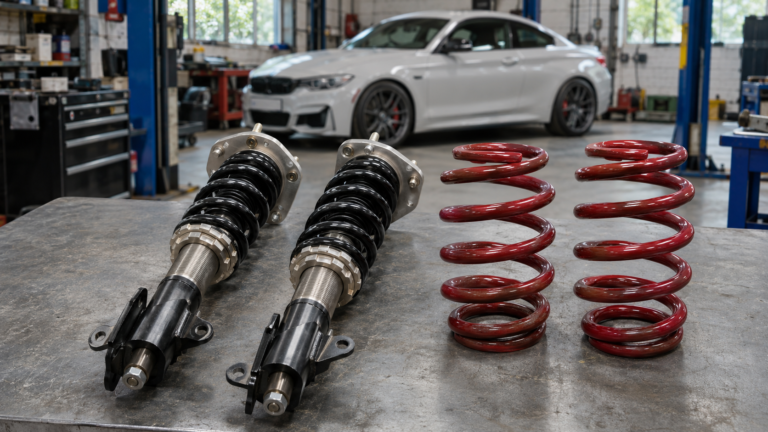
Shock absorbers, also called dampers, control how quickly the suspension compresses and rebounds. In a conventional suspension, the springs support the car’s weight; the dampers stop it continuing to oscillate after a disturbance. A strut combines the damper with a structural role in the suspension.
Delphi explains how bushes control movement, while KYB outlines the different roles of springs and dampers.
Worn bushes vs worn shocks: symptom comparison
| Symptom | More suggestive of | What else needs checking |
|---|---|---|
| Repeated bouncing or floating after a bump | Reduced damping from a shock or strut | Springs, tyres and other suspension faults. |
| A knock as braking, acceleration or cornering loads change | A worn bush or joint allowing excess movement | Ball joints, mounts and loose fixings; noise alone cannot identify the part. |
| Rattling over small, sharp bumps | Bushes or other loose suspension parts | Anti-roll-bar links, damper mounts and brake hardware. |
| Wandering or a steering change under braking | Control-arm bush movement is one possibility | Tyre pressures, tyres, alignment, steering joints and brakes. |
| Cupped or scalloped tyre tread | Damping problems are possible | Wheel balance, tyres and other mechanical wear. Edge wear alone does not identify a shock fault. |
| Wet oil tracks down a damper | A leaking damper | The source and severity of the fluid; a light surface film is different from a substantial leak. |
| One corner sitting noticeably low | A spring or other ride-height problem | Load, spring seats and the vehicle’s suspension design; do not assume the shock is responsible. |
Use these clues to describe the complaint, rather than order replacement parts. Monroe lists common damper symptoms, and MEYLE explains how control-arm wear affects wheel guidance.
Signs that point more towards worn suspension bushes
Bushes become suspect when a noise or steering change follows a change in load: braking, pulling away, turning or crossing an uneven surface.
For example, a deteriorated control-arm bush can allow unwanted movement as braking forces act on the wheel. That may contribute to vague steering or uneven tyre wear. An anti-roll-bar bush can produce a different complaint, so “worn bushes” is not one single diagnosis.
Cracks need interpreting in context. Some bushes have moulded gaps, and flexible rubber is meant to move. Serious separation, deterioration or abnormal play matters more than a photograph of an unfamiliar rubber shape.
Signs that point more towards worn shocks
The stronger clue is poor control of movement after the initial bump. The car may keep bobbing, feel floaty or take longer to settle. Excessive transient pitching under braking can also justify a damping check.
A worn damper can have reduced performance without a dramatic visible leak. Conversely, slight oil misting does not automatically prove failure. Inspect its body, rod, mounting points, dust cover and bump stop alongside how the car behaves.
Do not rely on the old “push down and count the bounces” rule as a pass-or-fail test. Vehicle design can make that check ineffective. DVSA has explained the limitations of the bounce test.
What you can check safely at home
Park on firm, level ground and look for:
- Tyre problems: incorrect pressures, obvious damage or uneven wear.
- Uneven ride height: compare sides after allowing for passengers and luggage.
- Visible damage: a displaced spring, rubbing tyre or loose-looking component.
- A symptom pattern: note the speed, road surface, corner of the car and whether braking or steering triggers the noise.
Look only where you have safe access. Never get underneath a car supported only by its jack, and do not undo strut or spring fixings to investigate a noise.
Avoid deliberate swerving, hard braking or driving into potholes to reproduce a fault. If the car feels unsafe, arrange recovery rather than a road test.
What a proper garage inspection should include
A useful suspension inspection combines your description with physical checks. It should cover:
- Tyres and wheels, including pressures, wear and damage.
- Bushes and joints, checking condition and abnormal movement with the suspension supported appropriately for its design.
- Related components, including steering joints, anti-roll-bar links, springs, top mounts and fixings.
- Dampers, looking for substantial leakage, damage, insecure mountings and signs of reduced damping.
- A controlled road assessment, where the vehicle is safe to drive and the complaint needs confirming.
An unloaded suspension can behave differently from one carrying the car’s weight. The technician needs to distinguish normal compliance from wear, rather than treat every movement as a defect.
Monroe’s inspection guidance combines vehicle history, ride assessment and physical checks. Ask the garage to show you the identified wear or explain the evidence behind its diagnosis.
Shawn’s mechanic’s advice
As a qualified mechanic, my advice is to describe when the problem happens before deciding which part has failed. “One knock when I first apply the brakes” gives a garage more to work with than “the suspension is worn”.
I would also ask what abnormal movement or loss of damping supports the diagnosis. A noise is a useful clue, but replacing parts without confirming its source can leave the original problem unresolved.
Can you drive with worn bushes or shocks?
There is no blanket safe mileage or time limit. The answer depends on the component, severity and effect on control.
Stop driving and arrange assistance if there is sudden steering change, severe instability, a visibly displaced wheel, a collapsed corner or a tyre rubbing against the body. A suspected loose or detached suspension component also needs urgent attention.
A mild new noise with otherwise normal handling still deserves a prompt inspection. Remote advice cannot confirm that a noisy car is safe to drive to a garage.
Will worn suspension fail an MOT?
It can. Under the DVSA MOT inspection manual for Great Britain, excessive joint or bush wear, severe damper leakage and negligible damping can be reasons for failure. A component likely to detach can be classed as dangerous.
However, slight damper seepage is not by itself a reason for rejection. Bush condition must also be judged against its design and deterioration, rather than assuming any crack or movement means failure.
An MOT pass is not a prediction of how long a component will last. Investigate new symptoms even if the car passed recently.
Replacement: pairs, complete arms and alignment
Damper manufacturers generally recommend replacing shocks as a matched pair on the same axle to avoid uneven damping. Follow the vehicle-specific requirements, particularly for adaptive or self-levelling systems.
For bushes, compare the complete fitted repair. A separate bush may be available, but pressing it into an old arm is not always the cheapest or most appropriate solution. Some designs require a complete component.
Correct installation matters too. Bonded-rubber control-arm bushes commonly require final tightening at the specified ride-height position; MOOG explains why tightening them while hanging can cause premature failure. The exact manufacturer’s procedure takes priority.
Ask whether the repair requires an alignment check. Fix excessive play before relying on alignment adjustments to cure pulling or tyre wear. Our guide to wheel alignment versus wheel balancing explains how those services differ.
Frequently asked questions
Can worn bushes make a car bounce?
They can contribute to unsettled behaviour, but repeated vertical oscillation after a bump points more towards damping. Bushes and shocks can both be worn, so the whole system needs checking.
Can a shock absorber knock without leaking?
Yes. Damper faults and worn mountings can produce noise without an obvious external leak. Ball joints, links and other components can sound similar.
How long should bushes and shocks last?
There is no universal replacement mileage. Design, age, roads, loading and use all affect wear. Follow the maintenance guidance and inspect when symptoms develop rather than relying on a fixed lifespan.
Will wheel alignment fix worn bushes?
No. Alignment changes the wheel settings; it does not repair a deteriorated mounting. Worn components need addressing first if they prevent the geometry remaining stable.